


Working Interview
Watch a candidate work a ticket
The candidate works realistic tickets like someone already in the role. You read the graded record, with the note behind every score.
Start with a free 30-day pilot. No contract.
Realistic tickets, real tools, scored part by part on that desk's rubric.
How it works
Three steps, start to finish
- 01
We agree the tickets with you
We walk the catalogue with you and pick the ones that match the role you are filling. Tier 1, 2 or 3, and as many as you want each candidate to work. We agree the set with you in writing before the interview runs: no surprises for you, and none for the candidate.
- 02
Your candidate works them
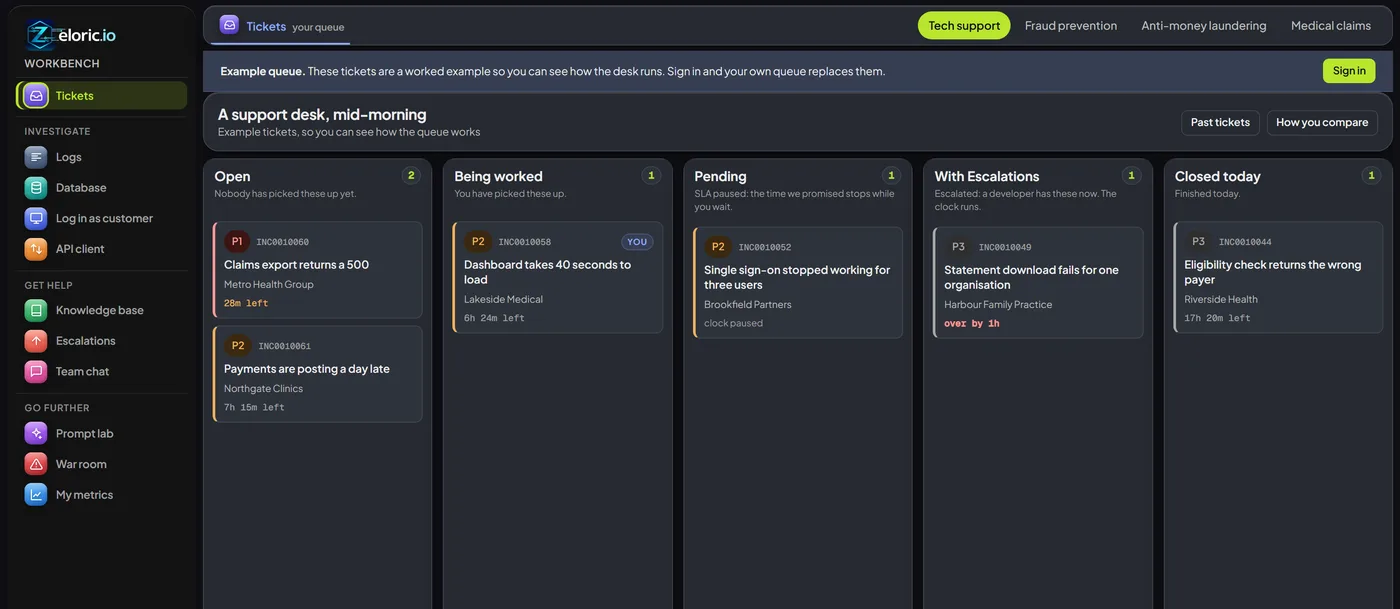
They open the desk for the role: a ticket, a case, an alert or a claim waiting, and tools that answer like the real ones. No multiple choice, no take-home essay. The work is real. They know it is graded, and they know who reads it.
- 03
You read the graded record
Every ticket scored on the same rubric we score members on, with the write-up behind each score. You read the work, not a summary of it.
What you get back
A record, not a verdict
We do not tell you who to hire. We show you what they did and how it was scored. You decide.
- A score on every dimensionThe same rubric every member is graded on, part by part, so one candidate's record means the same thing as the next one's.
- The write-up behind each scoreWhy that score and not a higher one. It is written to be argued with, which is the only way a score is worth anything to you.
- The transcript of the workWhat they said to the customer, which tools they opened, what they found and what they did about it.
85out of 100 overall
- Diagnostic quality90 out of 100
- Resolution correctness80 out of 100
- Communication clarity80 out of 100
- SLA discipline100 out of 100
- Tone & empathy90 out of 100
- Judgement70 out of 100
6 of the 11 parts, headline view. A record carries all 11.
Every score opens to the note behind it. Disagree with one? Dispute it.
An example
Read one before you commission one
Two links, nothing to sign: a ticket worked end to end, and a sample graded record.
The fair question
Is this fair to the candidate?
Do they know what it is for?
What do they get out of it?
Is a machine deciding?
What if they do badly?
Run one
Start with one candidate
Start with a free 30-day pilot. No contract.